Alla torsdagstips -> Alla kluringar -> Förra veckans kluring
Den med primtal
Minns du vad ett primtal är? Det är ett tal som är större än noll, och jämt delbart bara med sig själv och ett. Så två är ett primtal, för det är jämt delbart med sig själv (2/2=1) och med ett (2/1=2). Tre är också ett primtal, medans fyra inte är det (4/2=2).
Det finns ingen funktion i Excel för att ta reda på om ett tal är ett primtal eller inte, utan nu är det dags för dig att räkna lite. Men misströsta inte, du har fått hjälp av mig (beroende på hur du tänker lösa detta!).
Frågan är enkel, hur många primtal har vi mellan 1 till 35?
UPPDATERING
Det visar sig att ett inte är att anse som ett primtal, det hade jag faktiskt ingen koll på, men som någon kommenterade nedanför så är det inte det! Man lär sig saker hela tiden – helt enkelt! =)
Lösningar!
Bra jobbat alla ni som lyckades lösa den här veckans kluring. Det visar sig som någon skrev att ett inte är ett primtal så men det hade jag faktiskt ingen koll på!
Jag tycker om när någon dessutom skickade in en lösning först, och sedan ändrar sig och skickar in en annan – det är commitment! =)
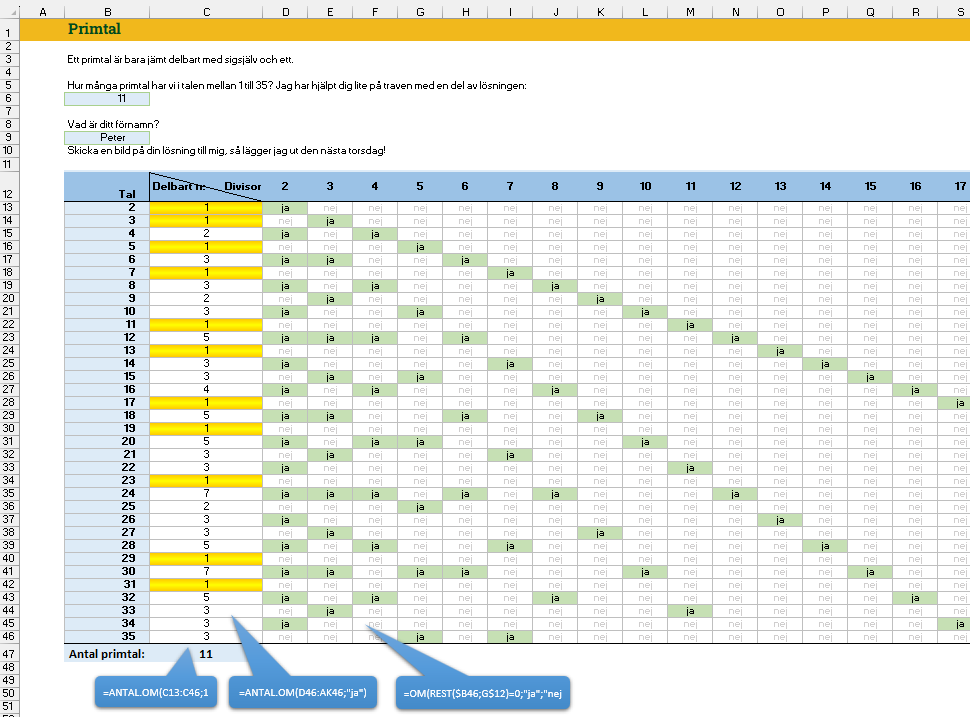
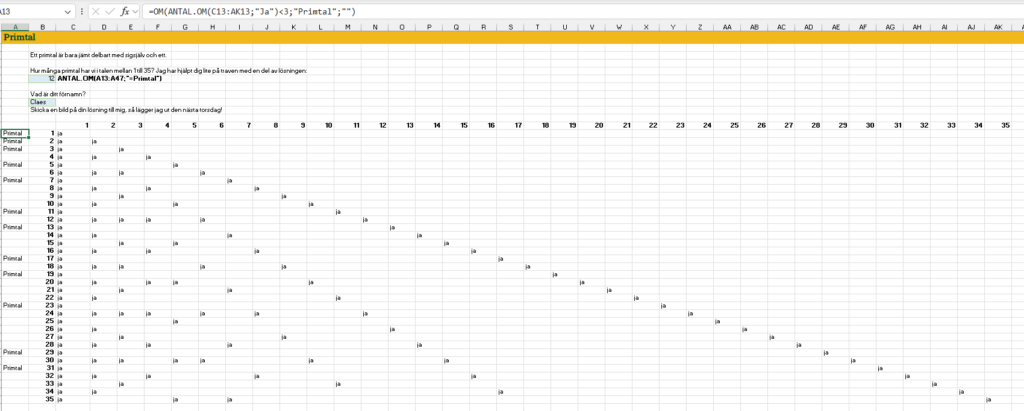
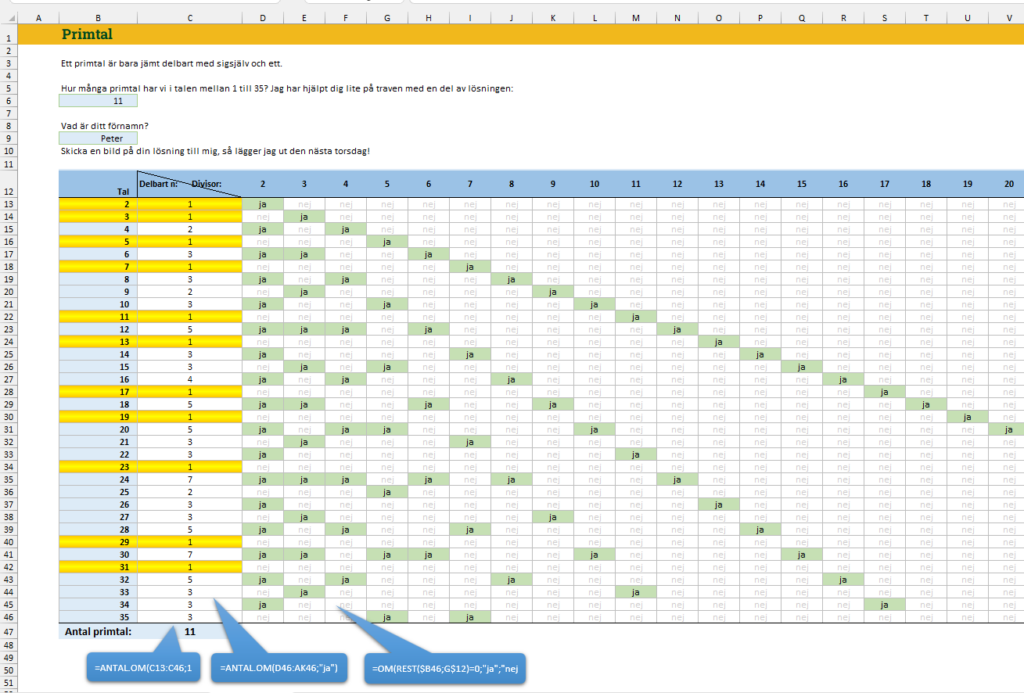
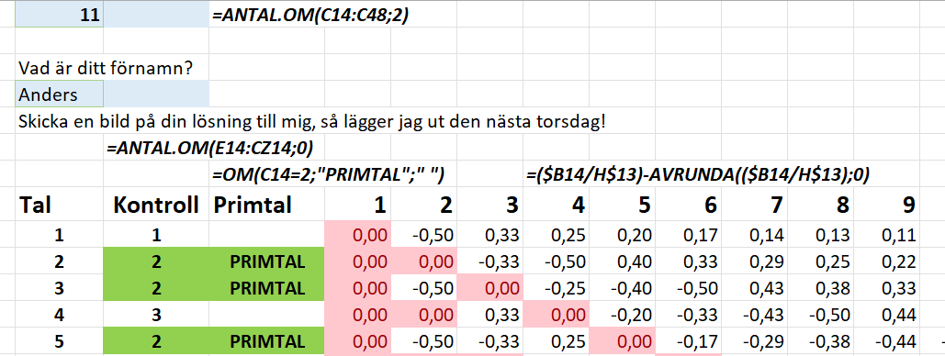
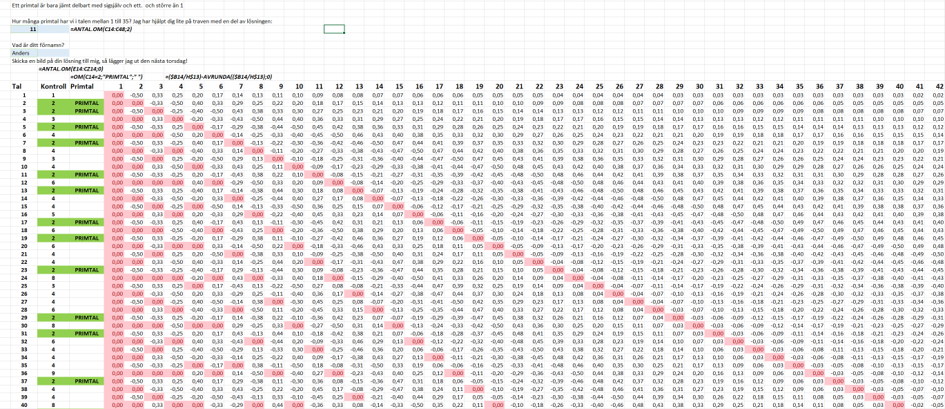


Ett bra tillfälle att tillämpa formeln =PRODUKTSUMMA(–AL13:AL47).
Dessvärre är inte 1 ett primtal enligt modern matematik:
https://en.wikipedia.org/wiki/Prime_number
Most early Greeks did not even consider 1 to be a number,[35][36] so they could not consider its primality. A few scholars in the Greek and later Roman tradition, including Nicomachus, Iamblichus, Boethius, and Cassiodorus, also considered the prime numbers to be a subdivision of the odd numbers, so they did not consider
2
{\displaystyle 2} to be prime either. However, Euclid and a majority of the other Greek mathematicians considered
2
{\displaystyle 2} as prime. The medieval Islamic mathematicians largely followed the Greeks in viewing 1 as not being a number.[35] By the Middle Ages and Renaissance, mathematicians began treating 1 as a number, and by the 17th century some of them included it as the first prime number.[37] In the mid-18th century, Christian Goldbach listed 1 as prime in his correspondence with Leonhard Euler;[38] however, Euler himself did not consider 1 to be prime.[39] Many 19th century mathematicians still considered 1 to be prime,[40] and Derrick Norman Lehmer included 1 in his list of primes less than ten million published in 1914.[41] Lists of primes that included 1 continued to be published as recently as 1956.[42][43] However, by the early 20th century mathematicians began to agree that 1 should not be listed as prime, but rather in its own special category as a “unit”.[40]
If 1 were to be considered a prime, many statements involving primes would need to be awkwardly reworded. For example, the fundamental theorem of arithmetic would need to be rephrased in terms of factorizations into primes greater than 1, because every number would have multiple factorizations with any number of copies of 1.[40][44] Similarly, the sieve of Eratosthenes would not work correctly if it handled 1 as a prime, because it would eliminate all multiples of 1 (that is, all other numbers) and output only the single number 1.[43] Some other more technical properties of prime numbers also do not hold for the number 1: for instance, the formulas for Euler’s totient function or for the sum of divisors function are different for prime numbers than they are for 1.[45]
A ha – vilken miss av mig – tack för att du hjälper till och bidrar med rättning! Då får vi se hur många som svarar med rätt eller fel antal, enligt den moderna matematiken, det var faktiskt riktigt intressant läsning, tyckte jag – tack för länken!